
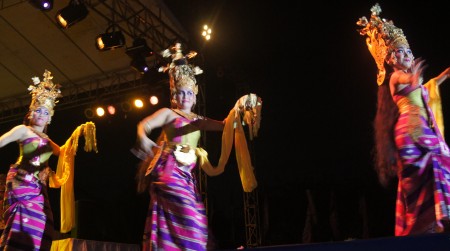
LEGONG KERATON
The most graceful of Balinese dances, this is the epitome of classical Balinese female dancing.
A legong, as the dancer is known, is often a young girl of eight or nine years, rarely older than her early teens. It was first created in the 18th Century and is usually the first dance to be taught to beginners. There are many forms of Legong, the most frequently performed dance being the Legong Keraton or Legong of the Palace.
The story of the Legong is very stylized and symbolic and one should know the story before actually watching the performance. The Legong involves three dancers - two legongs and their ''attendant'', the condong. The legongs are identically costumed in gold brocade, which is bound so tightly that it is a mystery such agitated and rapid moves could be made. With elaborately made-up faces, plucked eyebrows that are boldly repainted, and hair decorated with frangipanis, the dancers relate the story with captivating movements. A king takes the maiden Rangkesari captive. When her brother comes to release her, Rangkesari begs the king to free her rather than go to war. The king refuses and chances upon a bird carrying ill omens on his way to battle. However, he ignores the bird, meets Rangkesari's brother, and was thus killed in the fight.
The roles of the dancers may change according to the narration. However, the dance usually begins with the king's preparations for battle and ends with the bird's appearance.
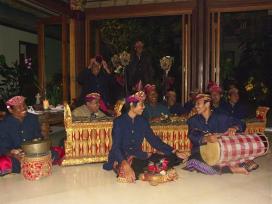
The gamelan is the Balinese orchestra that can be heard as a tribute to the Gods and deified ancestors in temple ceremonies, weddings, cremations, family temple ceremonies and procession. There are more than twenty different types of gamelan, each with their own traditions, repertoire, social and religious ...
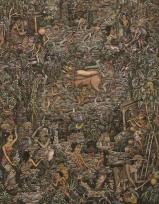
Ketut Murtika was born in Batuan around 1950 and became one of the most famous painters of the Batuan school, a painting style practiced by Brahman artists. His style captures Bali’s unique mystical atmosphere with ethereal depiction of everyday life scenes, landscapes and animals. His art has been shown worldwide, including France, ...
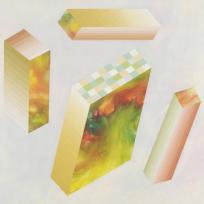
Dancer, musician and painter, Made Wianta is famous worldwide for his multi-influenced and often controversial ...
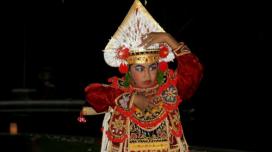
'Originally a religious ritual, Baris dance is probably the most complex of all Balinese dance, requiring a very rigorous training. Baris dancing is the male equivalent of the Legong dance. The name “Baris” means “line”, referring to the line of soldiers who served the Rajas of Bali in ancient times. Baris dance is a traditional war ...
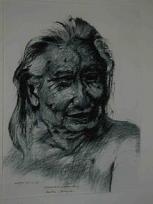
Ida Bagus Made was born In Tebasaya in 1915, from a Brhaman family of artists. He first started to learn painting from his father and later on under the teachings of Rudolph Bonnet, considered him the most talented artists in Bali. He developed his art during the movement of modernization of Balinese art. At 21 in he joined the Pitamaha ...
ARTIST OF THE WEEK

Bali has sure seen the birth and progress of numerous bands this year, and here we are, happy to do our part related to the births and happenings related to the island's music scene! We are sure passionate to cheer for the newcomers to make their way and earn their place, of course starting in the local scene. This week we...
CALENDAR

LIKE US
FOLLOW US


