
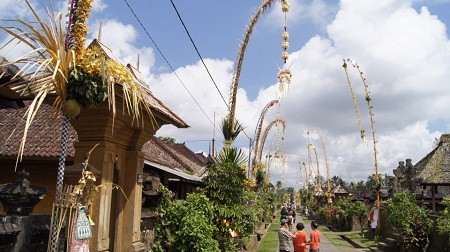
GALUNGAN & KUNINGAN
Held annually in the Wuku Calendar, the Galungan festivities last ten days, when Sanghyang Widi comes down to Earth.
Deified ancestors of the family come down to the family home. They must be entertained and are welcomed by prayers and offerings. Families who haven’t yet cremated their ancestors must bring offerings to their graves.
Even though Galungan is a family related festivity in the privacy of their homes, Bali is transformed as Penjors (wooden pole that you can see every where on the island) decorate the family house, offerings and beautiful decorations are set up everywhere on the island.
Women prepare colorful offering (“banten”) and food for offering and for the family, while men will wake up before dawn to sacrifice a pork.
When Galungan day finally comes up, it is time for Balinese to return to their family home and also to other families who may have helped them in the past 6 months.
Along with the celebration of ancestors, Galungan is a symbolic representation of the victory of Good over Evil.
The last and most important day is called Kuningan. The day after Kuningan is a holiday for everyone.
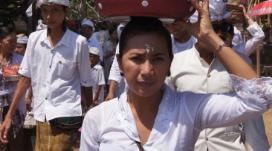
Nyepi is a Hindu Day of Silence or the Hindu New Year in the Balinese Saka calendar. The largest celebrations are held in Bali as well as in Balinese Hindu communities around Indonesia. Preparation for Nyepi begins about one month before especially with the building of Ogooh-Ogooh, giant representation of evil spirits. The tension becomes ...
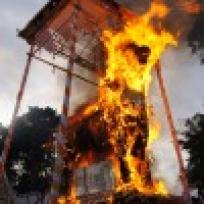
The cremation (Ngaben) ritual is perform to remind us of the cosmic nature of life. The tower represents the cosmos. The body is placed in the middle, as a symbol of its position, between the spiritual and the human worlds. The Sarcophagi, in which the body is burned, is the vehicule in which the soul leaves this world. ...
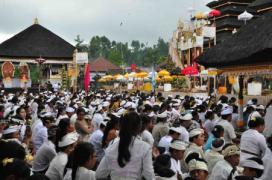
It means ''iron fence''. This celebration is all about protection in the everlasting battle of Good against Evil. Villagers raise penjors, as for Galungan, and bring offerings to their ancestors who haven’t been cremated yet. This ceremony takes place in Buleleng, in the northern parts of ...
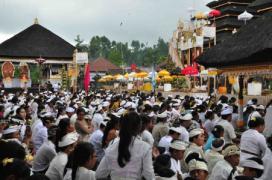
Eka Dasa Rudra is a series of processions, ceremonies, and sacrifices held every 100 years at Pura Besakih, the "mother temple" of Bali. Unfortunately, this magnificent ceremony is also a painful memory for Balinese people: On March 17, 1963, the Eka Dasa Rudra was under way when Agung catastrophically erupted and killed more ...
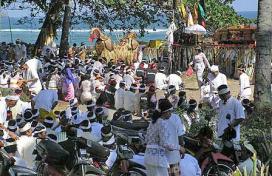
Melasti Ceremony is a Hindu religious ceremony to purify Bhuana Alit (small world) and Bhuana Agung (the universe), held as one of the rituals to welcome Nyepi Day (the Balinese New Year). This ceremony is performed with a parade procession followed by thousands of Balinese Hindu, bringing all the ceremony equipments, sacred objects from ...
ARTIST OF THE WEEK

Kacir Maitakai is a singer and musician from the exotic Alor Island in East Nusa Tenggara, who has been a Bali-based musician for over fifteen years now. He started tapping into his musical side in 1997 when he began playing the drums which was later on followed by his passion for guitar. After Kacir discovered his nice chemistry...
CALENDAR

LIKE US
FOLLOW US


