
Whale + Riders
In Uluwatu this past weekend surfers in the area encountered an Orca close to the famed surfing break in the Bukit. The Killer Whale or Orca whale (Orcinus orca) comes from the oceanic dolphin family, living as long, if not longer than we do with a complex culture and social structures, compared only to elephants and higher primates (yes that's us) and often travel in large groups. It's another reason it is inhumane to keep them in captivity (that's Sea World) as they are highly intelligent creatures coming second only to sperm-whales in having the largest brain of any animal.
The orca off Uluwatu was probably a male, as their dorsal fins are significantly more than twice the size of the female's and is more of a tall, elongated isosceles triangular shape when compared to the females shorter more curved fin. Younger animals stay close to the mother as the pods they travel in are 'matrilineal' groups. Copying and learning certain behaviors, some residents live with their mothers for their entire lives. Depending on the area they are in diets can vary from salmon, seals, porpoises, sea lions and off shore orcas have a taste for shark, with their teeth getting worn to the gums from chewing their rough skin. The mother will usually feed her offspring by holding a piece of fish in their mouth and her calves chew on it. A full grown orca can reach up to 9 meters in length in adulthood and females are said to breed until age 40, raising an average of 5 offsprings and can live a long life after that, with the longest living Orca (Granny or J2) estimating to be 103 years old, that's as old as the longest living human according to the Guniess Book of World Records.
To understand the complex society of the Orca a wikipedia search reveals,
"...closely related matrilines form loose aggregations called pods, usually consisting of one to four matrilines. Unlike matrilines, pods may separate for weeks or months at a time and males mate with females from other pods. Clans are the next level of the social hierarchy, composed of pods with similar dialects and a common but older maternal heritage. Clan ranges overlap, mingling pods from different clans. The final association layer is called the community and is defined as a set of clans that regularly commingle."
So what was the Orca doing in Uluwatu? Was it separated from a pod? Will it be back like 'Old Tom' the orca that would visit every winter for 90 years from 1840 to 1930 off New South Wales in Australia. Or is it a 'rover', a male that doesn't form long term associations, but occasionally joins groups that have 'reproductive' females much like the male species we see on Bali in the high season, usually on the prowl at night in bars and parties, with the occasional on Sunday's at Single Fin or Deus maybe. The answer's are endless, but if they're anything like Orca's in British Columbia they could just have an itch to scratch, "rubbing beaches" or scraping along pebbly rocks for some body scratching. They are said to be frequently active at the surface, engaging in acrobatic behaviors like breaching and spy hopping.
While killer whales are found in all oceans and most seas, with the largest population residing in Antarctic waters, their migration patterns are still poorly understood apparently with 'Resident' killer whales traveling as much as 160 km in a day but may be seen in a general area in a month or more. The group sizes range from 2-5 (transients) to 3-30 (residents) to 30-80 (offshore) and a recent consensus suggest an absolute minimum of 50,000 worldwide. They are said to have good eyesight above and below the water, excellent hearing, and a good sense of touch with a great echolocation system that allows them to detect location of prey and other objects as they emit clicks and listen for echoes. Dialects of killer whales not only separate and distinguish between pods but also types, with residents containing up to 17 call types, with different vocalizations for activities like hunting and traveling.
Killer whales have always been present in historical myths and legends, sometimes called the human 'soul' depicted as gods or deities that bring divine peace, luck and harmony to their tribes and the world. Other times they are depicted as vicious beast, swallowing sailors and destroying ships. If you re-watch the classic whale movie "Free Willy" and do a little research you'll find out they're not a threat to humans, and frankly anything keeping sharks aways is okay in my book. Another famous whale story in popular culture that has been given the Hollywood treatment with a twist originally is inspired (but not based on) the Maori myth of Paikea the Whale rider. The story of Paikea is about the favorite son of chief Uenuku who was saved from his jealous brothers' attempted murder at sea by reciting a poem which summoned a humpback whale that saved him.
Jonah the whale was spat out of a whale after repenting his ways to God, and 'Yu-kiang' a mythical creature in China, was a whale believed to rule the ocean that turned into a giant bird when he was angered causing terrible wind storms at sea, sounding like something out of a Hayao Miyazaki film. Similarily, the Kwakwaka'wakw myths or the indigenous people of the Pacific NW coast, believed also that killer whales embody the souls of deceased chiefs. They are regarded as rulers of the undersea world and live in houses with sea lions for slaves, and according to the story take on human form when submerged while humans who drowned would go to live with them.
The native Americans have the story of Natsiline, whose cedar wood carving of a killer whale comes to life after he helps the son of the chief of a sea lions. It comes to life and kills his bothers, who had left him to die on a deserted island, while taking a vow to never kill again and only help humans. The Inuit people of the Arctic share a story of a big raven, actually a deity in human form, that finds a stranded whale and asks the great spirit for help. The great spirit tells the raven if he wants to help the whale he has to go to place in the forest where the moonlight falls in a special way, finding a special mushroom that if eaten would grant him the strength to carry the whale back to the Ocean. In Siberia they are said to turn into wolves at winter (whales at summer) assisting hunters, while in Vietnam (present day) whales are said to bring luck, safety and prosperity while a beached whale is buried and mourned as is part of their family.
Despite all of this, the human consumption of whales continues in Japan, Norway, Iceland, Foroe Islands and other cultures that have a long tradition of whaling with the Minke whale and the humpback being most commonly sought after. In Norway, where some of my distant ancestors hail, whale meat was a cheap and common food in the 80s. In Japan the belly or 'whale bacon' and tail meat are popular with those who consume whale. But there are two sides to every story and not everyone has a craving for whale meat. Infact much the world condem the killing of these majestic animals. Eco-warriors or 'eco-terrorist' as they've been referred as, like the Sea Shepherd Conservation Society (SSCS) use direct action to combat whalers. They were covered in Animal Planet's 'Whale Wars' that filmed a standoff betweeen the organization's vessel and Japanese whalers at sea.
One thing we can all agree on (with the exception of whale hunters in Japan, Norway, and Sea World advocates) is that whales are extraordinary creatures that should be respected and a species to be protected. Our ancestors carved their likeness into totem poles and stone preceding written language, and this should be a reminder to us all that they've been around for a long time, remember and revered for a reason.
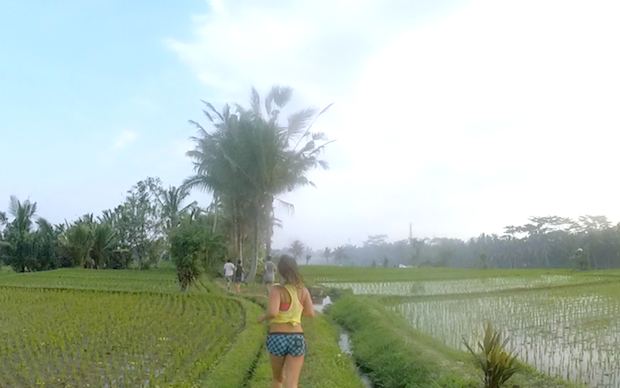
I've heard about the Hash runs before, the group famously known for their tag line of 'drinkers with a running problem' but had never tried a run until coming to Bali. Hash House Harriers or 'hashers' as they are called, have been doing this sort of thing for decades being a non competitive social running club. ...

The town of Negara is part of the island which is normally best known for being that last town before reaching the west exit of the island, Gilimanuk Port. West Bali is within the area of Jembrana regency, which over the years has made its efforts in improving the promotion of region's tourist attractions, surf spots and unique features it ...

Two days ago the 11th Annual Rip Curl Padang Cup kicked off day one during an epic sunset session with 24 tube riding pros all pumped and to get spit out of some heavy pits at Padang Padang. From former champ Chris Ward, seasoned tube riders like Hawaii ‘s Kalani Chapman and pro’s Matt Wilkinson, Owen Wright, Bethany Hamilton ...
When it comes to the celebration of the diverse colors in traditional culture, the blend of generations-old heritage combined with today's modern influence, all kind of brought together by appreciation and enthusiasm towards life, art, tradition, roots and everything that's beautiful, Bali sure has its very own occasions to highlight ...

It is that time of the year again; it is spring in France! Why and how it has remotely anything to do with us who are here on this tropical all-year summer side of the world; is simply that we'll get the chance to enjoy Printemps Français 2016! And in case you weren't quite sure, ‘printemps' does indeed translate ...
ARTIST OF THE WEEK

Bali has sure seen the birth and progress of numerous bands this year, and here we are, happy to do our part related to the births and happenings related to the island's music scene! We are sure passionate to cheer for the newcomers to make their way and earn their place, of course starting in the local scene. This week we...
CALENDAR

LIKE US
FOLLOW US


